
Arrest Warrants in East Hartford
An East Hartford arrest warrant is a judge-signed order that authorizes police to take the person named on it into custody. Probable cause is the whole foundation. The judge needs a reasonable basis, built on facts, to believe an offense happened and that the accused committed it. An officer, an investigator, or a prosecutorial authority develops those facts first. A sworn complaint and affidavit then carry the factual basis to a Superior Court judge. Local cases never route to a Hartford County sheriff or an East Hartford municipal criminal court. Connecticut abolished county sheriffs in 2000, and the Superior Court serves as the trial court for criminal matters. Many East Hartford cases pass through Geographical Area No. 12 at Manchester, while serious or transferred cases may land in the Hartford Judicial District. Wherever the docket sits, that location decides which clerk can confirm an outstanding warrant for you.
East Hartford Bad-Check Application Path
The EHPD bad-check packet shows, in concrete local terms, how facts move toward an arrest-warrant request. It is a complainant-side packet. It is not a self-check or a form for clearing a warrant. The blanks ask for the accused and business facts, check details, identification used, notice and return-receipt details, why payment was refused, and a sworn signature. The prosecuting authority receives the original application and affidavit. The East Hartford Police packet page explains that the packet is available at the police front desk, and the blank official application includes the judge's probable-cause finding and court-use fields. The division of work is plain there. A complainant supplies the facts, police and prosecutors review them, and the judge alone decides whether judicial process may issue in East Hartford. Note: Filing a complaint does not itself create an East Hartford arrest warrant; judicial review and a signed court order are required.
What East Hartford Arrest Warrants Contain
The full court or police record often holds more than the limited public lookup shows. No official East Hartford warrant-number format has been established, so copy a number only from personal papers or a clerk's confirmation. A public screen may leave out the judge, the full charge, the affidavit, the bond, the serving agency, or the warrant number. The current court file controls in the end.
| Warrant or incident number | A court or police routing identifier; no local format should be guessed. |
|---|---|
| Docket and court | The Superior Court case number and GA 12, Hartford JD, or other assigned location. |
| Named subject | Identity details used to match the order to the correct person. |
| Charge and statute | The alleged offense, classification, count, or complaint reference. |
| Issue information | Issue date and the judicial authority that signed the process. |
| Release terms | Written promise, bond without surety, surety bond, special terms, or an authorized hold. |
| Service and status | Serving agency, service date, active, executed, recalled, quashed, or other disposition. |
East Hartford Police arrest-log schemas can add detail: an arrest number, the booking agency, the arrest date and time, the charge description, its count, and release disposition. An arrest log is history, not current status. It cannot prove a warrant remains active.
East Hartford Affidavit Access Limits
Arrest-warrant affidavits can be sealed or withheld where disclosure could harm an investigation or someone's safety. Juvenile and youthful-offender records get extra protection. Connecticut's public VOP/FTA/OTI page says it may omit a warrant when posting could endanger safety, and it excludes youthful-offender process. Search-warrant affidavits sit in a separate investigative category under § 54-33a and may be restricted too. Connecticut FOIA generally backs access to public-agency records, but General Statutes § 1-210 carries law-enforcement and other exemptions. A narrow request to the EHPD Freedom of Information Office can seek releasable service or police records. For the current docket, judicial status, bond, and any recall decision, the court clerk remains the source. Missing public affidavit text is an access limit, not proof that the East Hartford warrant is invalid.
Record limit: A public search can be incomplete even when an East Hartford arrest warrant remains valid in authorized systems.
How East Hartford Arrest Warrants Are Served
Once a warrant is signed, its data can enter the state's authorized criminal-justice network. The Paperless Arrest Warrant Network overview says participating agencies receive electronic warrant information and can identify the responsible agency during inquiry and custody processing. PRAWN stays closed to the public.
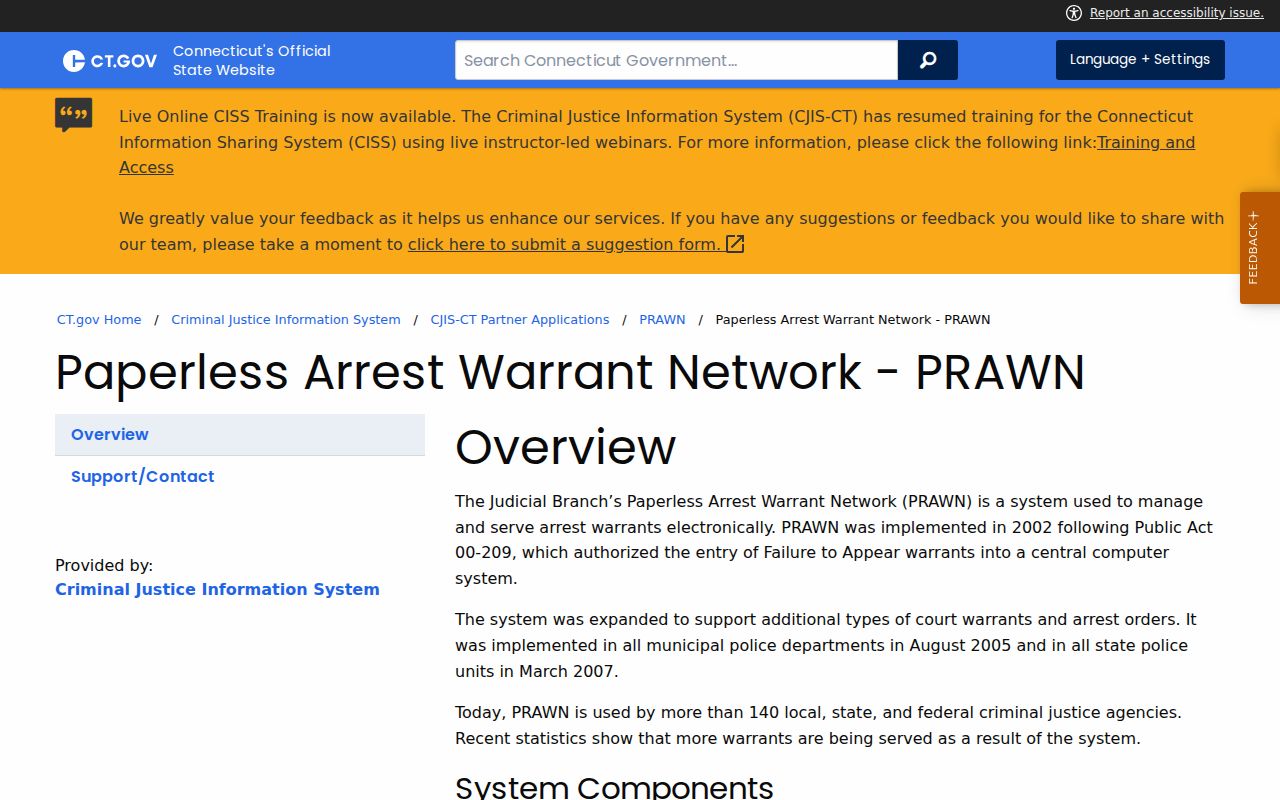
The system overview ties the signed court process to police inquiry, service, and booking. EHPD, another municipal department, Connecticut State Police, or another authorized peace officer may execute the criminal warrant. Judicial marshals handle security and custody inside the courthouse. State marshals mainly serve civil process and family capias. They are not the ordinary criminal-arrest warrant unit. At arrest, officers verify identity and the warrant, complete booking, and decide whether release fits the stated terms or court presentation is required. If local release is unavailable, custody can move to the Connecticut Department of Correction. The DOC inmate search is a custody tool after arrest or transfer, not an East Hartford warrant lookup.
East Hartford Warrant Service Roles
Several agencies can touch one East Hartford case without doing the same job. Matching your question to the right office saves a wasted call to a records unit that cannot change a judicial order.
| Agency | Role |
|---|---|
| East Hartford Police | Local investigation, warrant-application liaison, service, booking, and police records. |
| Municipal police or State Police | May execute Connecticut process within their authority and coordinate with the court. |
| Judicial marshals | Courthouse security and custody, not a public warrant-confirmation desk. |
| State marshals | Civil and family capias service; they do not set or accept bond. |
| U.S. Marshals | Federal warrant and fugitive work on the separate federal track. |
The EHPD official page links to Connecticut's warrant lookup instead of posting a local arrest-warrant roster. For a local routing question, call the routine line at 860-528-4401. For judicial status, call the assigned Superior Court clerk.
Arrest, Summons, and Bench Warrants
Each paper demands something different. An arrest warrant orders custody once a judge finds probable cause. A summons or notice to appear simply directs the person to come to court, with no custody at the start. Bench, rearrest, and capias warrants usually answer a missed appearance or a broken order in a pending case, though Connecticut law also permits a bench-warrant application built on probable cause alone.
| Feature | Arrest Warrant | Summons | Bench Process |
|---|---|---|---|
| What it directs | Arrest and custody processing | Appearance on the stated date | Custody tied to a court issue |
| Typical basis | Probable cause for an offense | Charge handled without initial custody | Missed date, breached order, or authorized application |
| First response | Clerk and counsel plan | Attend as directed | Confirm docket and recall route |
| Proof afterward | Disposition or release record | Docket entry | Recall, quash, or new-date order |
A missed date turns a summons into warrant process. The separate East Hartford bench warrant record explains FTA, rearrest, and capias terms.
East Hartford Bond Conditions
When a judge signs criminal process in East Hartford, release terms are set under § 54-2a. The choices run from a written promise to appear, to a bond without surety, to a bond with surety when the law allows it. Serious nonbailable offenses follow their own rules. East Hartford publishes no arrest-warrant bond schedule, no online warrant-bond portal, and no GA 12 bond-window hours. So confirm the exact condition with the assigned clerk first. Ask where the bond must be posted. Ask what payment the authorized East Hartford location accepts. The EHPD front desk may not take it. Neither may a state marshal. A surety fee paid to a licensed bondsman is not the same as court cash that may be refundable under the court's terms. Posting bond settles custody and release, not the case, which still needs court action. Note: Bring government identification and the docket details only after counsel or the clerk confirms the correct appearance and custody location.
East Hartford Controlled Appearance Questions
East Hartford publishes no walk-in-surrender guide or special warrant-window hour. An unplanned visit can mean immediate custody before medical, family, or counsel arrangements are in place. A Connecticut defense attorney can call the clerk or prosecutor. The lawyer can ask whether a controlled walk-through is available and whether a motion to recall or quash is legally appropriate.
- What court and docket hold the arrest warrant now?
- Does the court direct an appearance, police surrender, or another custody site?
- What release condition or bond is written in the warrant?
- May counsel arrange the time and required documents?
- What proof will show service, recall, release, or the next date?
The GA 12 clerk answers at 860-647-1091. EHPD's routine line is 860-528-4401 when the local agency handled the investigation or service. Use the official directory for Hartford Judicial District cases.
Resolve East Hartford Arrest Warrants
Confirm the warrant first. Use the limited state warrant lookup, the criminal case search, and the assigned East Hartford clerk. Read the live warning on that screen. FTA results are not displayed until further notice, and the tool does not include all warrant types. Say nothing about the allegation during an unscheduled police contact in East Hartford. Counsel can arrange a lawful response. If surrender is directed, bring identification, docket details, prescription or medical information, and the counsel or family contacts the plan requests. Booking may involve identity checks, warrant verification, court presentation, and a release review. After court action, get paper. A receipt, release document, stamped order, docket entry, or new court date shows where things stand. Ask when public and law-enforcement systems should reflect the new status.
Important: Confirm the court and speak with counsel before any surrender; finding a warrant online does not recall, quash, satisfy, or resolve it.
A recall withdraws the process. A quash order sets it aside. Execution means the warrant was carried out. Each status must come from the court or an authorized agency, not from a vanishing line on a partial search screen.